Pet poisoning statistics: what poisons dogs and cats, how often, and what treatment costs
ASPCA Poison Control handled more than 376,000 exposures of pets to toxins in 2025: about 1,030 a day, or one every 84 seconds. The most common were over-the-counter medicines and supplements (16.9% of exposures), human food and drink (16.4%) and human prescription medicines (14.6%). Source: ASPCA, March 2026 release, data as of December 2025.
Key statistics
- ASPCA Poison Control handled more than 376,000 exposures to toxins in 2025 and helped more than 334,000 animals, 3.7% more animals than in 2024. (ASPCA, March 2026 release)
- That is about 1,030 exposures a day, or one every 84 seconds (our calculation). (ASPCA, March 2026 release)
- Over-the-counter medicines and supplements were the most common pet toxin in 2025, at 16.9% of exposures, or about 174 exposures a day; they have topped ASPCA’s list for eight years running. (ASPCA, March 2026 release)
- Chocolate made up 13.6% of exposures in 2025: about 140 exposures a day, or one every 10 minutes (our calculation). (ASPCA, Top 10 Toxins of 2025; ASPCA, March 2026 release)
- More than 10,600 animals were exposed to xylitol, the sweetener in sugar-free gum, in 2025: about 29 animals a day. (ASPCA, March 2026 release)
- In 50% to 75% of ASPCA’s cases in 2025, its experts judged that the animal could be safely managed at home. (ASPCA, March 2026 release)
- ASPCA Poison Control helped one animal for every 500 pet dogs and cats in the U.S. in 2025 (our calculation, using AVMA’s pet counts). (ASPCA, March 2026 release; AVMA pet ownership, 2026)
- Animal exposures reported to U.S. human poison centers fell 73.2% between 2008 and 2024, from 130,495 to 34,919, while human exposures fell 16.0%. (NPDS annual report 2008; NPDS annual report 2024)
- In 2024, ASPCA Poison Control helped about 9.3 animals for every animal exposure that U.S. human poison centers logged (our calculation). (ASPCA newsletter, Fall 2025; NPDS annual report 2024)
- ASPCA’s hotline took 34 years to reach its two millionth case, and about 12.6 more years to reach five million. (ASPCA, two-millionth-case release; ASPCA, five-million-case release)
- Poisoning claims among Trupanion-insured U.S. pets have become more frequent since 2020, by more than 30% for dogs and 50% for cats; the average invoice was $1,396 for xylitol, $866 for chocolate and $847 for grapes and raisins. (Trupanion, March 2026 release)
- In CareCredit’s 2025–2026 national price study, an emergency exam for a dog averaged $135 and hospitalization at an emergency clinic $1,323. (CareCredit, procedure cost table)
What poisons pets: ASPCA’s top ten toxins
ASPCA Poison Control ranks the substances behind the calls it takes each year. In 2025, over-the-counter medicines and supplements came first, at 16.9% of exposures, followed by human food and drink (16.4%), human prescription medicines (14.6%) and chocolate (13.6%). Over-the-counter products have held the top spot for eight years; ASPCA links part of the latest rise to skin-care products such as face masks and creams. (ASPCA, March 2026 release; ASPCA, Top 10 Toxins of 2025)
Grapes, raisins, onions, garlic and xylitol-sweetened gum make up most of the food and drink calls. ASPCA helped more than 10,600 animals exposed to xylitol in 2025, among them dogs, cats, rabbits, pigs, birds and ferrets. Rodenticides were 6.5% of exposures, about 67 a day. (ASPCA, March 2026 release; ASPCA, Top 10 Toxins of 2025)
We turned each share into a daily count by applying it to ASPCA’s total of more than 376,000 exposures. Chocolate comes to about 140 exposures a day, or one every 10 minutes, and over-the-counter medicines to about 174 a day. ASPCA gives its total as a lower bound, so these counts are lower bounds too. (ASPCA, March 2026 release; ASPCA, Top 10 Toxins of 2025)
Every category’s share moved by less than a percentage point between 2024 and 2025. ASPCA ranked prescription medicines third in 2024 without publishing their share. (ASPCA, Top 10 Toxins of 2024; ASPCA, Top 10 Toxins of 2025)
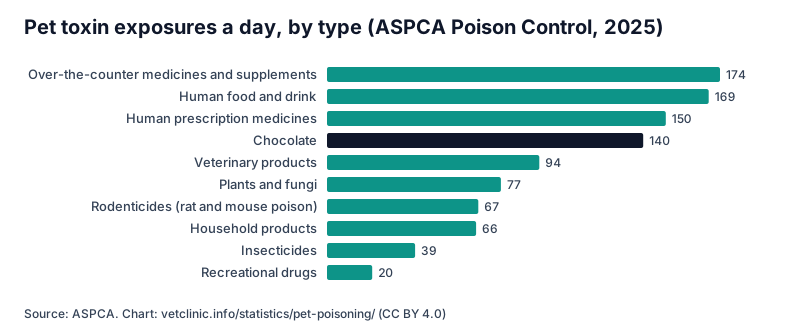
| Rank | Toxin category | 2025 share | 2024 share | A year (our est.) | A day (our est.) | What ASPCA names in the category |
|---|---|---|---|---|---|---|
| 1 | Over-the-counter medicines and supplements | 16.9% | 16.5% | 63,500 | 174 | Vitamins, dietary supplements, pain medicines; in 2025 also skin-care products such as face masks and creams |
| 2 | Human food and drink | 16.4% | 16.1% | 61,700 | 169 | Grapes, raisins, onions, garlic, xylitol-sweetened gum |
| 3 | Human prescription medicines | 14.6% | Not published | 54,900 | 150 | Heart medicines, antidepressants, ADHD medicines |
| 4 | Chocolate | 13.6% | 13.6% | 51,100 | 140 | Most often eaten by dogs |
| 5 | Veterinary products | 9.1% | 8.6% | 34,200 | 94 | Flavored chewable tablets and soft chews, such as calming and joint chews |
| 6 | Plants and fungi | 7.5% | 8.1% | 28,200 | 77 | Indoor and outdoor plants |
| 7 | Rodenticides (rat and mouse poison) | 6.5% | 7.0% | 24,400 | 67 | Rodent bait |
| 8 | Household products | 6.4% | 6.5% | 24,100 | 66 | Cleaners and paints |
| 9 | Insecticides | 3.8% | 3.7% | 14,300 | 39 | Insect killers and their packaging |
| 10 | Recreational drugs | 1.9% | 2.1% | 7,100 | 20 | Marijuana, hallucinogenic mushrooms, kratom |
Download the data (CSV) (ASPCA, Top 10 Toxins of 2025; ASPCA, March 2026 release; ASPCA, Top 10 Toxins of 2024)
How many pets are poisoned each year
No source counts every poisoned pet. The largest count we found comes from ASPCA Poison Control, a hotline staffed by 63 veterinarians, 25 of them board-certified in toxicology, which may charge a consultation fee. It handled more than 376,000 exposures in 2025 and helped more than 334,000 animals, 3.7% more animals than in 2024. (ASPCA, five-million-case release; ASPCA Poison Control; ASPCA, March 2026 release)
ASPCA reports a different unit from year to year. For 2024 it reported 451,712 calls about 323,380 animals, nearly 4% more calls than the year before; for 2025 it reported exposures and animals. Calls, exposures and animals are different counts, so only the animal counts compare across the two years. (ASPCA newsletter, Fall 2025; ASPCA, March 2025 release; ASPCA, March 2026 release)
Set against AVMA’s estimate of 88.9 million pet dogs and 77.0 million pet cats in 2026, ASPCA helped one animal for every 500 dogs and cats. Its animal count includes other species, though dogs and cats dominate it: in its cases from 2002 to 2012, 83.6% involved dogs and 13.9% cats. (AVMA pet ownership, 2026; ASPCA, March 2026 release; ASPCA, two-millionth-case release)
In 50% to 75% of its 2025 cases, ASPCA’s experts judged that the animal could be safely managed at home, and told the owner or the veterinarian who called that the exposure was not severe. (ASPCA, March 2026 release)
Animal calls to human poison centers have fallen by almost three-quarters
The National Poison Data System, run by America’s Poison Centers, records the calls to the U.S. network of human poison centers, including calls about animals. Animal exposures fell from 130,495 in 2008 to 34,919 in 2024, down 73.2%. Human exposures fell 16.0% over the same years. (NPDS annual report 2008; NPDS annual report 2024; poison.org, national statistics 2024)
ASPCA’s hotline grew over roughly the same years. It began in 1978 at the University of Illinois and took 34 years to reach its two millionth case, in December 2012; about 12.6 years later, by July 2025, it had passed five million. (ASPCA, two-millionth-case release; ASPCA, five-million-case release)
In 2024, ASPCA helped 323,380 animals: about 9.3 for every animal exposure the human poison centers logged. These counts show where owners called. They do not show why fewer animal calls reach the human centers, and we do not guess at a reason. (ASPCA newsletter, Fall 2025; NPDS annual report 2024)
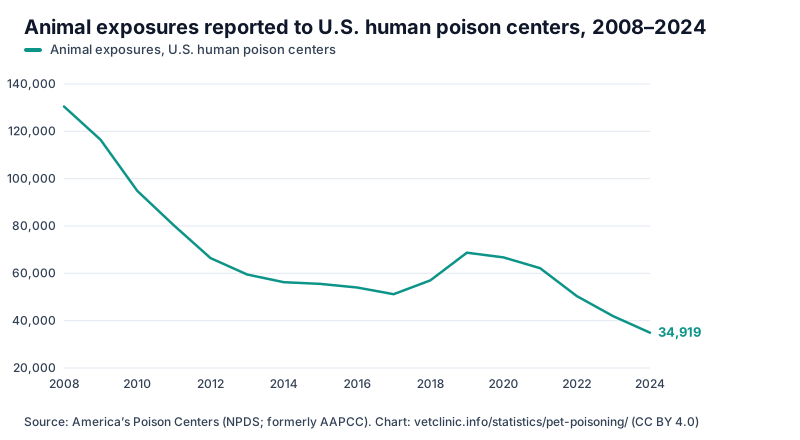
| Year | Animal exposures | Human exposures | Source |
|---|---|---|---|
| 2008 | 130,495 | 2,491,049 | NPDS annual report 2008 |
| 2009 | 116,408 | 2,479,355 | NPDS annual report 2009 |
| 2010 | 94,823 | 2,384,825 | NPDS annual report 2010 |
| 2011 | 80,266 | 2,334,004 | NPDS annual report 2011 |
| 2012 | 66,440 | 2,275,141 | NPDS annual report 2012 |
| 2013 | 59,496 | 2,188,013 | NPDS annual report 2013 |
| 2014 | 56,265 | 2,165,142 | NPDS annual report 2014 |
| 2015 | 55,516 | 2,168,371 | NPDS annual report 2015 |
| 2016 | 54,019 | 2,159,032 | NPDS annual report 2016 |
| 2017 | 51,164 | 2,115,186 | NPDS annual report 2017 |
| 2018 | 57,017 | 2,099,751 | NPDS annual report 2018 |
| 2019 | 68,711 | 2,148,141 | NPDS annual report 2019 |
| 2020 | 66,745 | 2,128,198 | NPDS annual report 2020 |
| 2021 | 62,189 | 2,080,917 | NPDS annual report 2021 |
| 2022 | 50,381 | 2,064,875 | NPDS annual report 2022 |
| 2023 | 41,857 | 2,080,659 | NPDS annual report 2023 |
| 2024 | 34,919 | 2,092,689 | NPDS annual report 2024 |
Download the data (CSV) (NPDS annual report 2008; NPDS annual report 2009; NPDS annual report 2010; NPDS annual report 2011; NPDS annual report 2012; NPDS annual report 2013; NPDS annual report 2014; NPDS annual report 2015; NPDS annual report 2016; NPDS annual report 2017; NPDS annual report 2018; NPDS annual report 2019; NPDS annual report 2020; NPDS annual report 2021; NPDS annual report 2022; NPDS annual report 2023; NPDS annual report 2024)
What poisoning treatment costs: insurer claims
Trupanion, a pet insurer, published its poisoning claims from 2020 onward in March 2026: more than 71,000 claims across the U.S. and Canada. Among its insured U.S. pets, poisoning claims have become more frequent since 2020, by more than 30% for dogs and 50% for cats. (Trupanion, March 2026 release)
Grapes and raisins were the most common source, with 11,588 U.S. claims at an average invoice of $847. The costliest of the common poisons to treat were xylitol ($1,396) and human or veterinary medicines ($1,387); onions and other alliums were the cheapest, at $558. (Trupanion, March 2026 release)
Trupanion calls these figures the average invoice; its study page calls them the average cost of treatment. They describe insured pets only. (Trupanion, March 2026 release; Trupanion, poisoning claims study)
| Toxicant | U.S. claims | Average invoice |
|---|---|---|
| Grapes and raisins | 11,588 | $847 |
| Chocolate | 6,186 | $866 |
| Drugs and medication (human and veterinary) | 6,086 | $1,387 |
| Rodenticides | 2,985 | $787 |
| Plants | 2,638 | $1,219 |
| Xylitol (gum) | 2,330 | $1,396 |
| Other food (caffeine, alcohol and similar) | 1,134 | $863 |
| Cannabis | 1,129 | $880 |
| Onions and other alliums | 548 | $558 |
| Insecticides | 135 | $1,117 |
| Fertilizer | 67 | $742 |
What an emergency visit costs
No public dataset counts how many poisoned pets are seen in emergency clinics, or what those visits cost. What is published are average prices for the items an emergency bill is made of.
In the national price study that ASQ360° Market Research conducted for Synchrony’s CareCredit in 2025 and 2026, across all states and DC, an emergency exam for a dog averaged $135, an IV catheter with one bag of fluid $130, and hospitalization at an emergency clinic $1,323. For cats, the emergency visit base fee averaged $143, and hospitalization at an emergency clinic $1,144. (CareCredit, procedure cost table)
Some swallowed objects need surgery or endoscopy rather than treatment for poisoning. CareCredit puts surgery for an ingested foreign body at $4,383 for a dog and emergency foreign body removal at $2,367 for a cat; a general practice in Minneapolis quotes $1,700–$2,800, and a Florida surgical practice charges $1,000 all-inclusive for endoscopy. (CareCredit, procedure cost table; Access Veterinary Care; Veterinary Surgery Service, endoscopy)
| Item | Species | Published figure | What the figure is | Source | Our guide |
|---|---|---|---|---|---|
| Emergency exam | Dog | $135 | National average, 2025–2026 national price study across all states and DC, conducted by ASQ360° for Synchrony (CareCredit) | CareCredit, procedure cost table | — |
| Emergency visit (base fee) | Cat | $143 | National average, 2025–2026 national price study across all states and DC, conducted by ASQ360° for Synchrony (CareCredit) | CareCredit, procedure cost table | — |
| IV catheter and one bag of fluid | Dog | $130 | National average, 2025–2026 national price study across all states and DC, conducted by ASQ360° for Synchrony (CareCredit) | CareCredit, procedure cost table | — |
| IV catheter and one bag of fluid | Cat | $121 | National average, 2025–2026 national price study across all states and DC, conducted by ASQ360° for Synchrony (CareCredit) | CareCredit, procedure cost table | — |
| Hospitalization at an emergency clinic | Dog | $1,323 | National average, 2025–2026 national price study across all states and DC, conducted by ASQ360° for Synchrony (CareCredit); length of stay not stated | CareCredit, procedure cost table | — |
| Hospitalization at an emergency clinic | Cat | $1,144 | National average, 2025–2026 national price study across all states and DC, conducted by ASQ360° for Synchrony (CareCredit); length of stay not stated | CareCredit, procedure cost table | — |
| Hospitalization at a veterinary clinic | Dog | $619 | National average, 2025–2026 national price study across all states and DC, conducted by ASQ360° for Synchrony (CareCredit); length of stay not stated | CareCredit, procedure cost table | — |
| Hospitalization at a veterinary clinic | Cat | $582 per day | National average, 2025–2026 national price study across all states and DC, conducted by ASQ360° for Synchrony (CareCredit) | CareCredit, procedure cost table | — |
| Oxygen therapy, small dog | Dog | $1,194 | National average, 2025–2026 national price study across all states and DC, conducted by ASQ360° for Synchrony (CareCredit) | CareCredit, procedure cost table | — |
| Oxygen therapy, large dog | Dog | $1,861 | National average, 2025–2026 national price study across all states and DC, conducted by ASQ360° for Synchrony (CareCredit) | CareCredit, procedure cost table | — |
| Emergency surgery to remove a foreign body | Cat | $2,367 | National average, 2025–2026 national price study across all states and DC, conducted by ASQ360° for Synchrony (CareCredit) | CareCredit, procedure cost table | Foreign body surgery guide |
| Surgery for an ingested foreign body (non-emergency enterotomy) | Dog | $4,383 | National average, 2025–2026 national price study across all states and DC, conducted by ASQ360° for Synchrony (CareCredit) | CareCredit, procedure cost table | Foreign body surgery guide |
| Foreign body surgery | Dog or cat | $1,700–$2,800 | General practice’s published estimate; more if part of the intestine must be removed | Access Veterinary Care | Foreign body surgery guide |
| Endoscopy | Not stated | $1,000 | Surgical practice’s all-inclusive fee; biopsy analysis may be extra | Veterinary Surgery Service, endoscopy | Endoscopy guide |
Download the data (CSV) (CareCredit, procedure cost table; Access Veterinary Care; Veterinary Surgery Service, endoscopy)
Methodology
Hotline counts show who called, not how often poisoning happens. ASPCA Poison Control may charge a consultation fee, and the human poison centers hear only from people who choose to call them. Pets whose owners call no one, or go straight to a veterinarian, are not counted, and one animal can be the subject of more than one call.
ASPCA’s units change from year to year. For 2025 it reports exposures, the items animals were exposed to, and animals helped; for 2024, calls and animals. Every figure on this page names its unit. Category shares are shares of exposures, as ASPCA publishes them.
Daily counts are our calculation: ASPCA’s total exposures multiplied by a category’s share, divided by the days in the year and rounded to a whole number. The yearly estimates in the table are rounded to the nearest hundred. Because ASPCA gives its total as “more than”, these are lower bounds.
One animal per 500 pet dogs and cats divides AVMA’s estimate of 88.9 million dogs and 77.0 million cats by ASPCA’s count of more than 334,000 animals, rounded to the nearest ten. AVMA’s estimate comes from its 2026 Pet Ownership and Demographic Sourcebook, an opt-in online survey of 7,547 people weighted to the U.S. population.
Human poison center figures are the animal and human exposure counts stated in the abstract of each annual report of the National Poison Data System, 2008 to 2024. The reports for 2008 and 2009 count calls captured; later reports count closed encounters. The ratio to ASPCA uses ASPCA’s count of 323,380 animals in 2024, from its Fall 2025 newsletter.
ASPCA’s milestone intervals run from its founding year, 1978, to the release of December 2012 announcing its two millionth case, and from there to the release of July 2025 saying it had recently passed five million. Both are approximate.
Trupanion figures are quoted from its March 2026 media release. Its study page, published the same day, gives a few figures differently, for example $737 rather than $787 for rodenticides; we quote the release.
Emergency prices are national averages from CareCredit’s price study and two published practice prices, not bills for poisoning cases. ASPCA’s March 2026 release also cites an owner survey about affording emergency care; it publishes no method for that survey, so this page does not use its figures.
Nothing on this page comes from the vetclinic.info directory of practices. Our tables and charts are licensed CC BY 4.0; the figures we quote remain their publishers’, so cite them as listed under Sources.
Frequently asked questions
How many pets are poisoned each year?
No one counts every case. ASPCA Poison Control handled more than 376,000 exposures and helped more than 334,000 animals in 2025, and U.S. human poison centers logged another 34,919 animal exposures in 2024. Both count calls to a hotline, not poisonings. (ASPCA, March 2026 release; NPDS annual report 2024)
What is the most common poison for pets?
Over-the-counter medicines and supplements: 16.9% of the exposures ASPCA Poison Control handled in 2025, about 174 exposures a day. They have topped ASPCA’s list for eight years. (ASPCA, March 2026 release)
How many dogs eat chocolate?
ASPCA does not split its chocolate figure by species, but says dogs are the most common culprit. Chocolate was 13.6% of its 2025 exposures, about 140 exposures a day across all species. (ASPCA, Top 10 Toxins of 2025)
How many dogs are poisoned each year?
No source counts poisoned dogs nationally. In ASPCA’s cases from 2002 to 2012, 83.6% involved dogs, and among Trupanion-insured U.S. dogs, poisoning claims have become more frequent by more than 30% since 2020. (ASPCA, two-millionth-case release; Trupanion, March 2026 release)
How much does it cost to treat a poisoned dog?
It depends on the poison. Trupanion’s average invoice for poisoning claims was $866 for chocolate, $847 for grapes and raisins, $1,396 for xylitol and $1,387 for medicines. An emergency exam alone averages $135 for a dog. (Trupanion, March 2026 release; CareCredit, procedure cost table)
Can a poisoned pet be treated at home?
Only on expert advice. ASPCA’s experts judged that the animal could be safely managed at home in 50% to 75% of its 2025 cases. That judgment was made by a toxicologist on the phone, so call a poison line or an emergency vet before deciding. (ASPCA, March 2026 release)
How to cite or reuse these statistics
You are free to quote, chart and republish the figures on this page, including commercially, as long as you credit vetclinic.info with a link to this page. Suggested citation:
vetclinic.info Data. "Pet Poisoning Statistics 2026: What Poisons Dogs and Cats, How Often, and What Treatment Costs." vetclinic.info, updated November 7, 2026. https://vetclinic.info/statistics/pet-poisoning/Or as a link:
<a href="https://vetclinic.info/statistics/pet-poisoning/">Pet Poisoning Statistics 2026: What Poisons Dogs and Cats, How Often, and What Treatment Costs</a> (vetclinic.info)Licence: our compiled tables and charts are published under CC BY 4.0. Figures from the U.S. Bureau of Labor Statistics and the Census Bureau are public domain; figures from other publishers remain theirs, so cite them as listed under Sources.
Sources
- Majority of America’s Pet Owners Unprepared for Costly Medical Emergencies, New ASPCA Report Warns, ASPCA (2026-03-11). Retrieved November 7, 2026.
- The Top 10 Toxins of 2025, ASPCA (2026-03-15). Retrieved November 7, 2026.
- ASPCA Sees Increase in Number of Calls to Poison Control Center in 2024, Including Rise in Cases Related to Hallucinogenic Mushroom Consumption, ASPCA (2025-03-12). Retrieved November 7, 2026.
- The Official Top 10 Toxins of 2024, ASPCA (2025-03-13). Retrieved November 7, 2026.
- Five Million Cases and Counting: ASPCA Poison Control Celebrates Huge Milestone (Legacy Society newsletter, Fall 2025), ASPCA (2025). Retrieved November 7, 2026.
- ASPCA Poison Control Reaches 5 Million Cases of Animal Exposures Since Hotline Inception Nearly 50 Years Ago, ASPCA (2025-07-22). Retrieved November 7, 2026.
- ASPCA’s Animal Poison Control Center Handles its 2 Millionth Case, ASPCA (2012-12-06). Retrieved November 7, 2026.
- ASPCA Poison Control, ASPCA. Retrieved November 7, 2026.
- National poison center statistics, 2024, National Capital Poison Center (poison.org). Retrieved November 7, 2026.
- 2008 Annual Report of the National Poison Data System (NPDS): 26th Annual Report, Clinical Toxicology, America’s Poison Centers (NPDS; formerly AAPCC) (2009). Retrieved November 7, 2026.
- 2009 Annual Report of the National Poison Data System (NPDS): 27th Annual Report, Clinical Toxicology, America’s Poison Centers (NPDS; formerly AAPCC) (2010). Retrieved November 7, 2026.
- 2010 Annual Report of the National Poison Data System (NPDS): 28th Annual Report, Clinical Toxicology, America’s Poison Centers (NPDS; formerly AAPCC) (2011). Retrieved November 7, 2026.
- 2011 Annual Report of the National Poison Data System (NPDS): 29th Annual Report, Clinical Toxicology, America’s Poison Centers (NPDS; formerly AAPCC) (2012). Retrieved November 7, 2026.
- 2012 Annual Report of the National Poison Data System (NPDS): 30th Annual Report, Clinical Toxicology, America’s Poison Centers (NPDS; formerly AAPCC) (2013). Retrieved November 7, 2026.
- 2013 Annual Report of the National Poison Data System (NPDS): 31st Annual Report, Clinical Toxicology, America’s Poison Centers (NPDS; formerly AAPCC) (2014). Retrieved November 7, 2026.
- 2014 Annual Report of the National Poison Data System (NPDS): 32nd Annual Report, Clinical Toxicology, America’s Poison Centers (NPDS; formerly AAPCC) (2015). Retrieved November 7, 2026.
- 2015 Annual Report of the National Poison Data System (NPDS): 33rd Annual Report, Clinical Toxicology, America’s Poison Centers (NPDS; formerly AAPCC) (2016). Retrieved November 7, 2026.
- 2016 Annual Report of the National Poison Data System (NPDS): 34th Annual Report, Clinical Toxicology, America’s Poison Centers (NPDS; formerly AAPCC) (2017). Retrieved November 7, 2026.
- 2017 Annual Report of the National Poison Data System (NPDS): 35th Annual Report, Clinical Toxicology, America’s Poison Centers (NPDS; formerly AAPCC) (2018). Retrieved November 7, 2026.
- 2018 Annual Report of the National Poison Data System (NPDS): 36th Annual Report, Clinical Toxicology, America’s Poison Centers (NPDS; formerly AAPCC) (2019). Retrieved November 7, 2026.
- 2019 Annual Report of the National Poison Data System (NPDS): 37th Annual Report, Clinical Toxicology, America’s Poison Centers (NPDS; formerly AAPCC) (2020). Retrieved November 7, 2026.
- 2020 Annual Report of the National Poison Data System (NPDS): 38th Annual Report, Clinical Toxicology, America’s Poison Centers (NPDS; formerly AAPCC) (2021). Retrieved November 7, 2026.
- 2021 Annual Report of the National Poison Data System (NPDS): 39th Annual Report, Clinical Toxicology, America’s Poison Centers (NPDS; formerly AAPCC) (2022). Retrieved November 7, 2026.
- 2022 Annual Report of the National Poison Data System (NPDS): 40th Annual Report, Clinical Toxicology, America’s Poison Centers (NPDS; formerly AAPCC) (2023). Retrieved November 7, 2026.
- 2023 Annual Report of the National Poison Data System (NPDS): 41st Annual Report, Clinical Toxicology, America’s Poison Centers (NPDS; formerly AAPCC) (2024). Retrieved November 7, 2026.
- 2024 Annual Report of the National Poison Data System (NPDS): 42nd Annual Report, Clinical Toxicology, America’s Poison Centers (NPDS; formerly AAPCC) (2025). Retrieved November 7, 2026.
- U.S. pet ownership statistics (2026 AVMA Pet Ownership and Demographic Sourcebook), American Veterinary Medical Association (2026). Retrieved November 7, 2026.
- New Trupanion Data Reveals Rise in Pet Toxicity Claims, Trupanion (2026-03-24). Retrieved November 7, 2026.
- Pet Poisoning Claims Are Up More Than 30% Since 2020, Trupanion (2026-03-24). Retrieved November 7, 2026.
- Veterinary Exam and Procedure Costs, CareCredit (Synchrony). Retrieved November 7, 2026.
- Surgery Services & Pricing, Access Veterinary Care (Minneapolis, MN). Retrieved November 7, 2026.
- Endoscopy, Veterinary Surgery Service (Fort Walton Beach, FL). Retrieved November 7, 2026.
How we compile these pages: editorial policy. Found an error? Write to [email protected] and we will correct it and note the change here.