Pet cancer statistics: how common it is, who treats it, and what it costs
Roughly 6 million dogs are diagnosed with cancer in the United States each year, and in December 2025 there were 656 board-certified veterinary oncologists to treat them: about 9,100 new canine cancer cases a year for each one. Source: NCI Comparative Oncology Program; AVMA specialists, end of 2025, data as of December 2025.
Key statistics
- About 1 in 4 dogs develop cancer at some point in their lives; for dogs aged 10 or older the risk is 1 in 2. (AVMA, Cancer in pets; Veterinary Cancer Society)
- Roughly 6 million dogs, and a similar number of cats, are diagnosed with new cancers in the United States each year. (NCI Comparative Oncology Program)
- There were 656 board-certified veterinary oncologists in December 2025: one for every 136,000 pet dogs, or about 9,100 new canine cancer diagnoses a year for each. (AVMA specialists, end of 2025; AVMA pet ownership, 2026; NCI Comparative Oncology Program)
- Only 164 veterinarians are board-certified in radiation oncology: one for every 542,000 pet dogs. (AVMA specialists, end of 2025; AVMA pet ownership, 2026)
- The number of board-certified veterinary oncologists grew 65.2% in nine years, from 397 at the end of 2016. (AVMA specialists, end of 2016; AVMA specialists, end of 2025)
- Lymphoma accounts for up to 24% of new cancers in dogs. (Veterinary Cancer Society)
- Treating a dog’s lymphoma costs $5,254 on average nationally, and from $4,269 for a cat. (CareCredit, chemotherapy)
- That is 6.2% of U.S. median household income, or about 3.2 weeks of a typical household’s income. (CareCredit, chemotherapy; Census ACS 2025, household income)
- Relative to income, a dog’s lymphoma treatment costs the most in Hawaii (8.9% of median household income) and the least in Virginia (5.1%). (CareCredit, chemotherapy; Census ACS 2025, household income)
- Mississippi has the cheapest dog lymphoma treatment of any state, $4,220, yet relative to income it is the third most expensive, at 7.1%. (CareCredit, chemotherapy; Census ACS 2025, household income)
- Insurers’ lymphoma figures measure different things: Nationwide members claimed $1,807 per pet in 2019, Trupanion reported $5,800 per year in a 2019 release, and Pets Best found $739 on average in its 2022 claims. (Nationwide, 2020; Trupanion, 2019; Pets Best)
- Of 652 golden retrievers necropsied at UC Davis between 1989 and 2016, 65.0% died or were euthanized because of cancer, most often hemangiosarcoma. (Kent et al., PLOS ONE, 2018)
How common cancer is in dogs and cats
About 1 in 4 dogs develop cancer during their lives, and the risk rises to 1 in 2 for dogs aged 10 or older, according to the American Veterinary Medical Association. The Veterinary Cancer Society gives the same lifetime figure and estimates that almost 50% of dogs over the age of 10 will develop cancer. (AVMA, Cancer in pets; Veterinary Cancer Society)
The National Cancer Institute’s comparative oncology program estimates that roughly 6 million dogs and a similar number of cats are diagnosed with new cancers in the United States each year. These are estimates: the Veterinary Cancer Society notes that the exact incidence is hard to determine, because not every pet receives veterinary care or a definitive diagnosis. (NCI Comparative Oncology Program; Veterinary Cancer Society)
Lymphoma accounts for up to 24% of new cancers in dogs, and osteosarcoma for 85% of skeletal tumors. Mast cell tumors are the most common skin tumors in dogs, and transitional cell carcinoma the most common tumor of the canine urinary system. (Veterinary Cancer Society)
Cancer is less common in cats than in dogs, according to AVMA, and much less is published about how often cats get it. (AVMA, Cancer in pets; Veterinary Cancer Society)
How many veterinary oncologists there are
In December 2025 AVMA counted 656 active board-certified veterinary oncologists, certified by the American College of Veterinary Internal Medicine, and 164 radiation oncologists, certified by the American College of Veterinary Radiology. Some veterinarians hold more than one specialty, so the two counts should not be added. (AVMA specialists, end of 2025)
Set against AVMA’s estimate of 88.9 million pet dogs in 2026, that is one oncologist for every 136,000 dogs, and one radiation oncologist for every 542,000. The 77.0 million pet cats add another 117,000 per oncologist. Set against NCI’s estimate of new canine cancers, it is about 9,100 new cases a year per oncologist. Against the whole population, it is one oncologist for every 521,000 U.S. residents. (AVMA specialists, end of 2025; AVMA pet ownership, 2026; NCI Comparative Oncology Program; Census Bureau, population)
The specialty is growing. Oncologists increased 65.2% between the end of 2016 and the end of 2025, and radiation oncologists 62.4%. The 56 oncologists added in 2025 are the largest one-year increase AVMA has published; it published no count for 2023. (AVMA specialists, end of 2016; AVMA specialists, end of 2017; AVMA specialists, end of 2018; AVMA specialists, end of 2019; AVMA specialists, end of 2020; AVMA specialists, end of 2021; AVMA specialists, end of 2022; AVMA specialists, end of 2024; AVMA specialists, end of 2025)
| End of year | Oncologists (ACVIM) | Radiation oncologists (ACVR) | Source |
|---|---|---|---|
| 2016 | 397 | 101 | AVMA specialists, end of 2016 |
| 2017 | 409 | 108 | AVMA specialists, end of 2017 |
| 2018 | 425 | 114 | AVMA specialists, end of 2018 |
| 2019 | 452 | 116 | AVMA specialists, end of 2019 |
| 2020 | 462 | 122 | AVMA specialists, end of 2020 |
| 2021 | 487 | 129 | AVMA specialists, end of 2021 |
| 2022 | 499 | 141 | AVMA specialists, end of 2022 |
| 2023 | Not published | Not published | — |
| 2024 | 600 | 154 | AVMA specialists, end of 2024 |
| 2025 | 656 | 164 | AVMA specialists, end of 2025 |
Download the data (CSV) (AVMA specialists, end of 2016; AVMA specialists, end of 2017; AVMA specialists, end of 2018; AVMA specialists, end of 2019; AVMA specialists, end of 2020; AVMA specialists, end of 2021; AVMA specialists, end of 2022; AVMA specialists, end of 2024; AVMA specialists, end of 2025)
Golden retrievers: the breed studied most closely
Morris Animal Foundation’s Golden Retriever Lifetime Study enrolled 3,044 golden retrievers between 2012 and 2015 and follows them for life, to identify risk factors for cancer and other diseases. By April 2026 it had recorded more than 1,700 confirmed cancer diagnoses. (Morris Animal Foundation, study page; Morris Animal Foundation, FAQ; Morris Animal Foundation, April 2026)
A study at the University of California, Davis, examined the 652 golden retrievers of known age that underwent necropsy at its veterinary teaching hospital between 1989 and 2016. Of these, 424 (65.0%) died or were euthanized because of cancer. Hemangiosarcoma, a cancer of the cells lining blood vessels, caused 22.6% of those cancer deaths, and lymphoid cancers 18.4%. (Kent et al., PLOS ONE, 2018)
These dogs were patients of a referral hospital whose owners agreed to a necropsy, so the share is not an estimate for golden retrievers in general. (Kent et al., PLOS ONE, 2018)
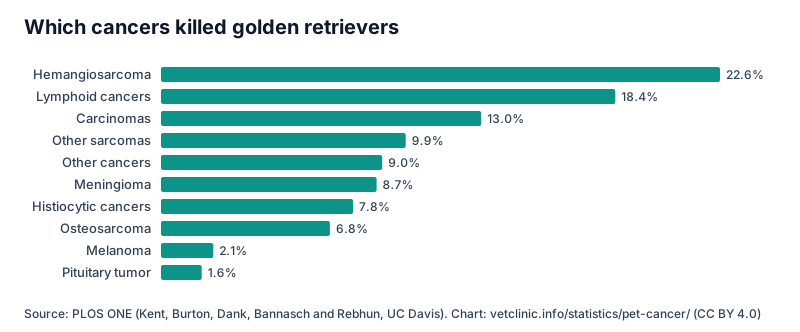
| Cancer | Dogs | Share of cancer deaths |
|---|---|---|
| Hemangiosarcoma | 96 | 22.6% |
| Lymphoid cancers | 78 | 18.4% |
| Carcinomas | 55 | 13.0% |
| Other sarcomas | 42 | 9.9% |
| Other cancers | 38 | 9.0% |
| Meningioma | 37 | 8.7% |
| Histiocytic cancers | 33 | 7.8% |
| Osteosarcoma | 29 | 6.8% |
| Melanoma | 9 | 2.1% |
| Pituitary tumor | 7 | 1.6% |
What cancer treatment costs
The Veterinary Cancer Society puts an initial oncology consultation at $125–$250, chemotherapy at $150–$600 per dose, and radiation at $1,000–$1,800 for a palliative protocol or about $4,500–$6,000 for a curative one. Cornell University’s animal hospital quotes approximately $2,500–$7,000 for radiation therapy, and the American Kennel Club puts chemotherapy at $3,000 to more than $10,000. (Veterinary Cancer Society; Cornell University Hospital for Animals; American Kennel Club)
Pet insurers publish averages from their claims, but each measures something different. For lymphoma, Nationwide members claimed an average of $1,807 per pet in 2019, Trupanion reported $5,800 per year in a 2019 release, and Pets Best found an average of $739 in its 2022 claims without saying whether that is per claim or per pet. The figures cannot be compared with each other, or with the price of a full course of treatment. (Nationwide, 2020; Trupanion, 2019; Pets Best)
Cancer brings repeated bills. In 2019 Nationwide received 106,585 cancer claims for 23,502 pets, about 4.5 claims per pet. The costliest of its ten most common cancer conditions was anal sac cancer, at $1,914 per pet. (Nationwide, 2020)
| Cancer or treatment | Species | Published figure | What the figure is | Date of figure | Source | Our guide |
|---|---|---|---|---|---|---|
| Lymphoma | Dog | $5,254 | Survey average, national; protocol not stated | 2025 survey | CareCredit, chemotherapy | Lymphoma (CHOP) guide |
| Lymphoma | Cat | from $4,269 | Survey average, national (“starts at”) | 2025 survey | CareCredit, chemotherapy | Lymphoma (CHOP) guide |
| Lymphoma | Not stated | $5,800 per year | Insurer claims: yearly cost | Five years of claims to Jan 2019 | Trupanion, 2019 | Lymphoma (CHOP) guide |
| Lymphoma | Not stated | $1,807 per pet | Insurer claims: average claimed per pet | 2019 claims | Nationwide, 2020 | Lymphoma (CHOP) guide |
| Lymphoma | Dog | $739 | Insurer claims: average from claims, per claim or per pet not stated | 2022 claims | Pets Best | Lymphoma (CHOP) guide |
| Mast cell tumor | Not stated | $2,400 per year | Insurer claims: yearly cost | Five years of claims to Jan 2019 | Trupanion, 2019 | Mast cell tumor removal guide |
| Mast cell tumor | Dog | $1,001 | Insurer claims: average from claims, per claim or per pet not stated | 2022 claims | Pets Best | Mast cell tumor removal guide |
| Mast cell tumor removal | Dog | $500–$1,500, plus several hundred to a thousand for diagnostics | Veterinarian-written estimate, surgery | Page updated Apr 2024 | PetMD | Mast cell tumor removal guide |
| Osteosarcoma | Not stated | $4,550 per year | Insurer claims: yearly cost | Five years of claims to Jan 2019 | Trupanion, 2019 | Osteosarcoma amputation guide |
| Osteosarcoma | Dog | $926 | Insurer claims: average from claims, per claim or per pet not stated | 2022 claims | Pets Best | Osteosarcoma amputation guide |
| Leg amputation (any reason) | Dog | $1,900–$2,100 | Clinic price list, front or hind leg | Not dated | Access Veterinary Care | Amputation guide |
| Hemangiosarcoma | Dog | $1,275 | Insurer claims: average from claims, per claim or per pet not stated | 2022 claims | Pets Best | Splenic hemangiosarcoma guide |
| Spleen removal (any reason) | Dog | $2,299–$2,849 | Nonprofit clinic price list | Not dated | Anicira Veterinary Center | Splenectomy guide |
| Spleen removal (any reason) | Dog | $2,300 | Clinic price list | Not dated | Access Veterinary Care | Splenectomy guide |
| Anal sac cancer | Not stated | $1,914 per pet | Insurer claims: average claimed per pet; the costliest of its ten most common cancer conditions | 2019 claims | Nationwide, 2020 | Anal sac tumor removal guide |
| Carcinoma | Not stated | $4,200 per year | Insurer claims: yearly cost | Five years of claims to Jan 2019 | Trupanion, 2019 | — |
| Adenocarcinoma | Not stated | $4,950 per year | Insurer claims: yearly cost | Five years of claims to Jan 2019 | Trupanion, 2019 | — |
| Adenocarcinoma | Dog | $1,056 | Insurer claims: average from claims, per claim or per pet not stated | 2022 claims | Pets Best | — |
| Sarcoma | Dog | $1,095 | Insurer claims: average from claims, per claim or per pet not stated | 2022 claims | Pets Best | — |
| Squamous cell carcinoma | Dog | $882 | Insurer claims: average from claims, per claim or per pet not stated | 2022 claims | Pets Best | — |
| Transitional cell carcinoma | Dog | $732 | Insurer claims: average from claims, per claim or per pet not stated | 2022 claims | Pets Best | — |
| Cancer, type not identified | Dog | $988 | Insurer claims: average from claims, per claim or per pet not stated | 2022 claims | Pets Best | — |
| Oncology consultation | Not stated | $125–$250 | Specialist society’s range, initial consultation | Not dated | Veterinary Cancer Society | — |
| Chemotherapy, per dose | Not stated | $150–$600 per dose | Specialist society’s range; usually includes the recheck exam and blood work | Not dated | Veterinary Cancer Society | Chemotherapy guide |
| Chemotherapy, full course | Dog | $3,000 to more than $10,000 | Breed registry’s range | Page updated Jan 2024 | American Kennel Club | Chemotherapy guide |
| Radiation therapy, palliative | Not stated | $1,000–$1,800 | Specialist society’s range | Not dated | Veterinary Cancer Society | Radiation therapy guide |
| Radiation therapy, curative intent | Not stated | about $4,500–$6,000 | Specialist society’s range | Not dated | Veterinary Cancer Society | Radiation therapy guide |
| Radiation therapy | Not stated | approximately $2,500–$7,000 | University hospital’s range; CT planning and intensive care extra | Not dated | Cornell University Hospital for Animals | Radiation therapy guide |
| Major cancer surgery | Not stated | from about $500 | University hospital’s starting point, by extent and recovery | Not dated | Cornell University Hospital for Animals | Tumor removal guide |
Download the data (CSV) (CareCredit, chemotherapy; Trupanion, 2019; Nationwide, 2020; Pets Best; PetMD; Access Veterinary Care; Anicira Veterinary Center; Veterinary Cancer Society; American Kennel Club; Cornell University Hospital for Animals)
Lymphoma treatment for a dog, by state, against household income
CareCredit’s 2025 price study puts the average cost of lymphoma therapy for a dog at $5,254 nationally, from $4,220 in Mississippi to $9,387 in Hawaii, a 2.2-fold difference. For cats, the national figure starts at $4,269. (CareCredit, chemotherapy)
We divided each state’s average price by its median household income from the Census Bureau’s 2025 American Community Survey. Nationally, the treatment costs 6.2% of a year’s median household income, about 3.2 weeks of income. The share is highest in Hawaii, at 8.9% (4.6 weeks), and lowest in Virginia, at 5.1% (2.7 weeks). 23 states, counting DC, are above the national share. (CareCredit, chemotherapy; Census ACS 2025, household income)
Price and burden do not line up. Mississippi has the cheapest treatment of any state, yet relative to income it is the third most expensive, at 7.1%: its lower prices do not make up for its lower incomes. (CareCredit, chemotherapy; Census ACS 2025, household income)
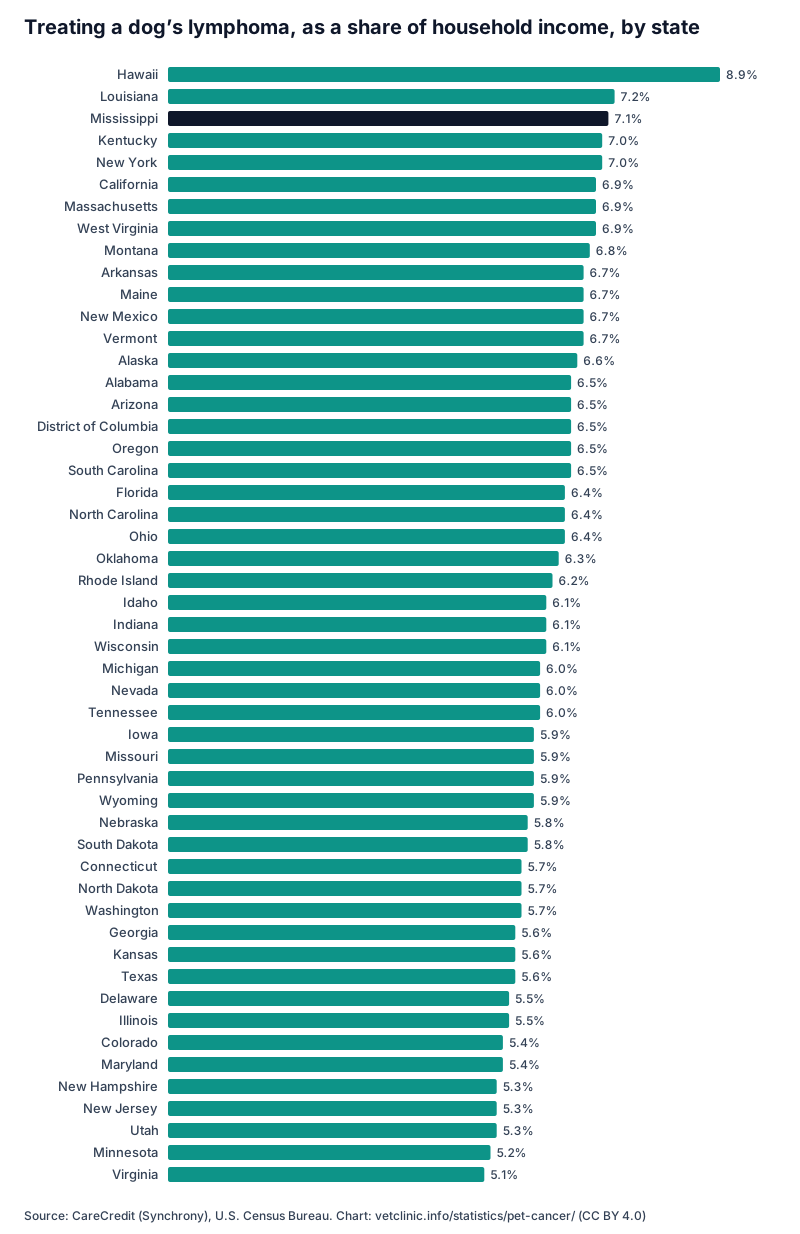
| Rank | State | Dog lymphoma treatment, % of median household income | Weeks of median household income | Dog lymphoma treatment, average | Cat lymphoma treatment, average | Median household income |
|---|---|---|---|---|---|---|
| 1 | Hawaii | 8.9% | 4.6 | $9,387 | $7,655 | $105,013 |
| 2 | Louisiana | 7.2% | 3.7 | $4,672 | $3,776 | $65,139 |
| 3 | Mississippi | 7.1% | 3.7 | $4,220 | $3,400 | $59,346 |
| 4 | Kentucky | 7.0% | 3.7 | $4,683 | $3,794 | $66,447 |
| 4 | New York | 7.0% | 3.6 | $6,212 | $5,047 | $89,210 |
| 6 | California | 6.9% | 3.6 | $7,019 | $5,700 | $102,159 |
| 6 | Massachusetts | 6.9% | 3.6 | $7,335 | $5,950 | $106,539 |
| 6 | West Virginia | 6.9% | 3.6 | $4,231 | $3,441 | $61,340 |
| 9 | Montana | 6.8% | 3.5 | $5,205 | $4,223 | $77,099 |
| 10 | Arkansas | 6.7% | 3.5 | $4,364 | $3,548 | $65,588 |
| 10 | Maine | 6.7% | 3.5 | $5,497 | $4,474 | $81,760 |
| 10 | New Mexico | 6.7% | 3.5 | $4,705 | $3,816 | $70,342 |
| 10 | Vermont | 6.7% | 3.5 | $5,789 | $4,693 | $86,018 |
| 14 | Alaska | 6.6% | 3.4 | $6,240 | $5,091 | $95,220 |
| 15 | Alabama | 6.5% | 3.4 | $4,413 | $3,597 | $67,663 |
| 15 | Arizona | 6.5% | 3.4 | $5,426 | $4,425 | $82,940 |
| 15 | District of Columbia | 6.5% | 3.4 | $7,104 | $5,776 | $109,505 |
| 15 | Oregon | 6.5% | 3.4 | $5,624 | $4,546 | $86,953 |
| 15 | South Carolina | 6.5% | 3.4 | $4,804 | $3,933 | $73,672 |
| 20 | Florida | 6.4% | 3.3 | $5,176 | $4,203 | $80,846 |
| 20 | North Carolina | 6.4% | 3.3 | $4,936 | $4,031 | $77,638 |
| 20 | Ohio | 6.4% | 3.3 | $4,760 | $3,843 | $74,804 |
| 23 | Oklahoma | 6.3% | 3.3 | $4,287 | $3,503 | $68,441 |
| 24 | Rhode Island | 6.2% | 3.2 | $5,673 | $4,617 | $91,039 |
| 25 | Idaho | 6.1% | 3.2 | $5,117 | $4,174 | $84,234 |
| 25 | Indiana | 6.1% | 3.2 | $4,567 | $3,705 | $74,516 |
| 25 | Wisconsin | 6.1% | 3.2 | $4,886 | $3,951 | $80,213 |
| 28 | Michigan | 6.0% | 3.1 | $4,573 | $3,696 | $75,832 |
| 28 | Nevada | 6.0% | 3.1 | $5,112 | $4,147 | $85,198 |
| 28 | Tennessee | 6.0% | 3.1 | $4,551 | $3,727 | $75,875 |
| 31 | Iowa | 5.9% | 3.1 | $4,507 | $3,664 | $76,483 |
| 31 | Missouri | 5.9% | 3.1 | $4,468 | $3,628 | $75,485 |
| 31 | Pennsylvania | 5.9% | 3.1 | $4,798 | $3,892 | $81,473 |
| 31 | Wyoming | 5.9% | 3.1 | $4,798 | $3,901 | $80,894 |
| 35 | Nebraska | 5.8% | 3.0 | $4,721 | $3,821 | $81,614 |
| 35 | South Dakota | 5.8% | 3.0 | $4,650 | $3,781 | $80,506 |
| 37 | Connecticut | 5.7% | 2.9 | $5,657 | $4,590 | $100,056 |
| 37 | North Dakota | 5.7% | 2.9 | $4,611 | $3,767 | $81,545 |
| 37 | Washington | 5.7% | 2.9 | $5,761 | $4,680 | $101,946 |
| 40 | Georgia | 5.6% | 2.9 | $4,617 | $3,727 | $81,847 |
| 40 | Kansas | 5.6% | 2.9 | $4,347 | $3,561 | $77,824 |
| 40 | Texas | 5.6% | 2.9 | $4,663 | $3,779 | $82,625 |
| 43 | Delaware | 5.5% | 2.9 | $5,128 | $4,201 | $92,520 |
| 43 | Illinois | 5.5% | 2.8 | $4,749 | $3,866 | $86,676 |
| 45 | Colorado | 5.4% | 2.8 | $5,343 | $4,304 | $99,729 |
| 45 | Maryland | 5.4% | 2.8 | $5,838 | $4,734 | $107,700 |
| 47 | New Hampshire | 5.3% | 2.8 | $5,646 | $4,617 | $106,759 |
| 47 | New Jersey | 5.3% | 2.8 | $5,750 | $4,675 | $107,797 |
| 47 | Utah | 5.3% | 2.7 | $5,227 | $4,237 | $99,311 |
| 50 | Minnesota | 5.2% | 2.7 | $4,826 | $3,910 | $92,297 |
| 51 | Virginia | 5.1% | 2.7 | $5,090 | $4,134 | $99,322 |
Download the data (CSV) (CareCredit, chemotherapy; Census ACS 2025, household income)
Methodology
How often pets get cancer is quoted as AVMA, the Veterinary Cancer Society and the National Cancer Institute publish it. These are estimates, not counts: none of the three pages gives the case counts behind its figure.
Oncologist counts are AVMA’s published counts of active board-certified diplomates in oncology (American College of Veterinary Internal Medicine) and radiation oncology (American College of Veterinary Radiology) at the end of each year. AVMA published no count for 2023. Some veterinarians hold more than one specialty.
Dogs per oncologist divides AVMA’s estimate of 88.9 million pet dogs (2026 Pet Ownership and Demographic Sourcebook) by the oncologist count, rounded to the nearest thousand. New cases per oncologist divides NCI’s rough estimate of 6 million new canine cancers a year by the same count, rounded to the nearest hundred; NCI states that estimate alongside an older pet population of 89.7 million dogs. Residents per oncologist uses the Census Bureau’s Vintage 2025 population estimate of 341,784,857. All three are ratios that show scale, not caseloads: some diplomates work in research, teaching, industry or abroad.
Treatment prices are quoted as each source publishes them, with what the figure measures and its date. CareCredit’s figures come from a 2025 price survey of every state and DC, conducted by ASQ360° for Synchrony; CareCredit does not say which treatment protocol they assume. Insurer figures come from each insurer’s claims: Nationwide’s are amounts members claimed per pet in 2019, Trupanion’s are yearly costs from five years of claims to January 2019, and Pets Best’s are averages over its 2022 claims. They are not comparable with each other or with a full course of treatment.
Share of income divides each state’s average dog lymphoma price by its median household income in the past twelve months, in 2025 dollars, from the 2025 American Community Survey one-year estimates (table B19013). Weeks of income is that share of a year’s income expressed in weeks. Income estimates carry margins of error, widest in small states, so states a few tenths of a point apart should be read as similar.
The golden retriever cause-of-death figures describe dogs necropsied at one referral hospital (UC Davis, 1989–2016), not golden retrievers in general. Morris Animal Foundation’s figure counts cancer diagnoses, not dogs, and a dog can have more than one.
Nothing on this page comes from the vetclinic.info directory of practices, which does not cover every state evenly. Our tables and charts are licensed CC BY 4.0; the figures we quote remain their publishers’, so cite them as listed under Sources.
Frequently asked questions
How common is cancer in dogs?
About 1 in 4 dogs develop cancer during their lives, according to AVMA and the Veterinary Cancer Society, and the risk rises to 1 in 2 for dogs aged 10 or older. (AVMA, Cancer in pets; Veterinary Cancer Society)
How common is cancer in cats?
Less is known. AVMA describes cancer as less common in cats than in dogs, and NCI estimates that the number of cats diagnosed with new cancers each year is similar to the roughly 6 million dogs. (AVMA, Cancer in pets; NCI Comparative Oncology Program)
How many veterinary oncologists are there in the U.S.?
AVMA counted 656 board-certified veterinary oncologists and 164 radiation oncologists in December 2025: one oncologist for every 136,000 pet dogs. (AVMA specialists, end of 2025; AVMA pet ownership, 2026)
How much does it cost to treat lymphoma in a dog?
CareCredit’s 2025 study puts the national average at $5,254, from $4,220 in Mississippi to $9,387 in Hawaii. Insurer claim averages are lower, but they measure claims, not a full course of treatment. (CareCredit, chemotherapy; Nationwide, 2020; Pets Best)
Which cancer kills the most golden retrievers?
In a UC Davis study of golden retrievers necropsied between 1989 and 2016, hemangiosarcoma caused 22.6% of cancer deaths, followed by lymphoid cancers at 18.4%. (Kent et al., PLOS ONE, 2018)
Can I reuse these statistics?
Yes. Our tables and charts are licensed CC BY 4.0, so you can quote, chart and republish them with a link to this page.
How to cite or reuse these statistics
You are free to quote, chart and republish the figures on this page, including commercially, as long as you credit vetclinic.info with a link to this page. Suggested citation:
vetclinic.info Data. "Pet Cancer Statistics 2026: How Common It Is, Who Treats It, What It Costs by State." vetclinic.info, updated November 2, 2026. https://vetclinic.info/statistics/pet-cancer/Or as a link:
<a href="https://vetclinic.info/statistics/pet-cancer/">Pet Cancer Statistics 2026: How Common It Is, Who Treats It, What It Costs by State</a> (vetclinic.info)Licence: our compiled tables and charts are published under CC BY 4.0. Figures from the U.S. Bureau of Labor Statistics and the Census Bureau are public domain; figures from other publishers remain theirs, so cite them as listed under Sources.
Sources
- Cancer in pets, American Veterinary Medical Association. Retrieved November 2, 2026.
- Pet Owner Resources (frequently asked questions), Veterinary Cancer Society. Retrieved November 2, 2026.
- About the Comparative Oncology Program, National Cancer Institute, Center for Cancer Research. Retrieved November 2, 2026.
- U.S. pet ownership statistics (2026 AVMA Pet Ownership and Demographic Sourcebook), American Veterinary Medical Association (2026). Retrieved November 2, 2026.
- Veterinary specialists in the U.S. (as of December 31, 2025), American Veterinary Medical Association. Retrieved November 2, 2026.
- Veterinary specialists 2024 (as of December 31, 2024), American Veterinary Medical Association. Retrieved November 2, 2026.
- Veterinary specialists 2022 (as of December 31, 2022), American Veterinary Medical Association. Retrieved November 2, 2026.
- Veterinary specialists 2021 (as of December 31, 2021), American Veterinary Medical Association. Retrieved November 2, 2026.
- Veterinary specialists 2020 (as of December 31, 2020), American Veterinary Medical Association. Retrieved November 2, 2026.
- Veterinary specialists 2019 (as of December 31, 2019), American Veterinary Medical Association. Retrieved November 2, 2026.
- Veterinary specialists 2018 (as of December 31, 2018), American Veterinary Medical Association. Retrieved November 2, 2026.
- Veterinary specialists 2017 (as of December 31, 2017), American Veterinary Medical Association. Retrieved November 2, 2026.
- Veterinary specialists 2016 (as of December 31, 2016), American Veterinary Medical Association. Retrieved November 2, 2026.
- State Population Totals: 2020–2025 (NST-EST2025), U.S. Census Bureau. Retrieved November 2, 2026.
- American Community Survey 2025 1-year estimates, table B19013: Median household income in the past 12 months (in 2025 inflation-adjusted dollars), U.S. Census Bureau. Retrieved November 2, 2026.
- Golden Retriever Lifetime Study, Morris Animal Foundation. Retrieved November 2, 2026.
- Golden Retriever Lifetime Study Frequently Asked Questions, Morris Animal Foundation. Retrieved November 2, 2026.
- What the Golden Retriever Lifetime Study tells us about dog health, Morris Animal Foundation (2026-04-23). Retrieved November 2, 2026.
- Association of cancer-related mortality, age and gonadectomy in golden retriever dogs at a veterinary academic center (1989-2016), PLOS ONE (Kent, Burton, Dank, Bannasch and Rebhun, UC Davis) (2018-02-06). Retrieved November 2, 2026.
- How Much Does Chemotherapy Cost for Dogs and Cats?, CareCredit (Synchrony) (2025-11-21). Retrieved November 2, 2026.
- Trupanion Reveals Top Drivers of Veterinary Costs in Cats and Dogs, Trupanion (2019-01-21). Retrieved November 2, 2026.
- November is National Pet Cancer Awareness Month, Nationwide (2020-10-30). Retrieved November 2, 2026.
- Coverage for Dogs & Cats with Cancer, Pets Best. Retrieved November 2, 2026.
- Cancer Management Frequently Asked Questions, Cornell University Hospital for Animals. Retrieved November 2, 2026.
- Cancer in Dogs: What to Do If Your Dog is Diagnosed With Cancer, American Kennel Club (2024-01-23). Retrieved November 2, 2026.
- Mast Cell Tumor (Mastocytoma) in Dogs, PetMD (2024-04-30). Retrieved November 2, 2026.
- Surgery Services & Pricing, Access Veterinary Care (Minneapolis, MN). Retrieved November 2, 2026.
- Affordable Splenectomy Surgery, Anicira Veterinary Center (Manassas, VA). Retrieved November 2, 2026.
How we compile these pages: editorial policy. Found an error? Write to [email protected] and we will correct it and note the change here.