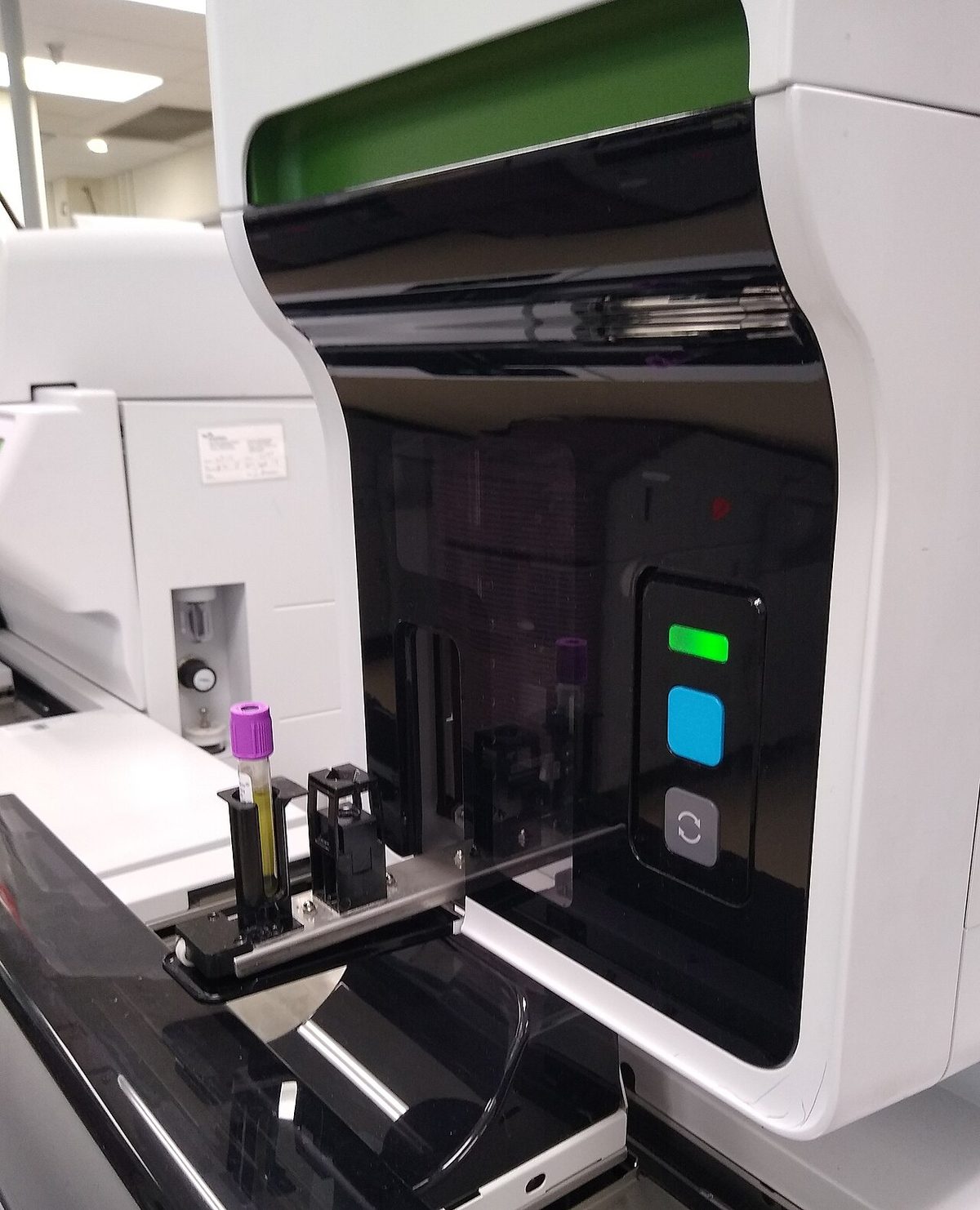
An in-house laboratory means your veterinary clinic runs blood and urine tests on its own analysers, in the building, while you wait — results in roughly 15 to 30 minutes rather than the one to three days a send-out reference lab takes. Typical cost is $80 to $300 depending on how much is run. The difference is not convenience. It is whether the vet knows what is wrong while the decision is still open.
What in-house testing actually looks for
A standard in-house panel answers a surprisingly large share of clinical questions:
- Complete blood count (CBC) — red cells (anaemia, blood loss), white cells (infection, inflammation) and platelets (clotting).
- Blood chemistry — kidney values, liver enzymes, blood glucose, protein and pancreatic markers.
- Electrolytes — sodium, potassium and chloride, which drive fluid therapy and can be immediately life-threatening when badly out of range.
- Urinalysis — concentration, infection, crystals, protein and glucose.
- Clotting times, and rapid "snap" tests for heartworm, feline leukaemia and FIV, parvovirus and pancreatitis.
What it does not replace
This is where honesty matters more than salesmanship. An in-house lab runs a fixed menu. Thyroid and adrenal panels, bacterial culture and sensitivity, tick-borne disease PCR, and anything involving a pathologist looking down a microscope — cytology, biopsy, histopathology — still go to a reference lab and still take days.
Speed is also not the same as accuracy. An in-house analyser counts cells by machine; a clinical pathologist reviewing a blood smear sees things a machine cannot flag. When a result is abnormal, or simply does not fit the animal in front of the vet, the smear or the reference lab is the confirmation. A good practice uses both, and a practice that sends everything out is not practising badly.
Where the speed genuinely changes the outcome
Several common situations turn on same-day numbers:
- Emergencies. A [collapsed dog](/emergency/is-my-dog-collapsing-an-emergency/) with pale gums might be bleeding internally, profoundly anaemic, or in metabolic crisis. Those need different treatment in the next few minutes, and bloodwork separates them.
- Before anaesthesia. Pre-anaesthetic bloodwork checks the organs that clear anaesthetic drugs. "My pet looks fine" is not a counter-argument — early kidney and liver disease are silent by design. See [anesthesia monitoring](/procedures/anesthesia-monitoring/) and [dental cleaning](/procedures/dental-cleaning/), where this is routine.
- Sick cats and vomiting patients, where kidney values and electrolytes change the fluid plan immediately.
- Suspected poisoning, where organ values decide whether treatment starts now or after observation.
- Deciding on a [blood transfusion](/procedures/blood-transfusion/) or escalating to [dialysis](/procedures/hemodialysis/) — both depend on numbers that cannot wait two days.
What it is like for your pet
Almost nothing. A small blood sample is drawn from a front or hind leg vein, usually in under a minute, often without sedation. A shaved patch over the vein is common. Urine may be collected by free catch or by cystocentesis — a fine needle into the bladder, frequently guided by [ultrasound](/procedures/ultrasound/), which sounds worse than it is and is over in seconds. Most animals object more to being held still than to the needle.
Species differences
In-house capability matters more for exotic pets, not less. Rabbits, guinea pigs, birds, ferrets and reptiles conceal illness until they are genuinely critical, so by the time an owner notices, a two-day turnaround is often too long — a [rabbit that has stopped eating](/emergency/is-my-rabbit-not-eating-an-emergency/) is a time-critical patient, not a fussy one. Small body size also limits how much blood can safely be drawn, which favours analysers that need tiny sample volumes.
Reference intervals differ by species too: a machine set up for dogs can mis-flag a normal avian or reptile sample. What matters is not only that a clinic has analysers, but that it works with species-appropriate reference ranges and sees enough exotic patients to interpret them.
How to tell whether a clinic actually has one
Ask directly, and ask three things:
1. "Is the lab on site, and what can you run today?" Some practices describe a courier collection as "in-house". 2. "If my pet is here for surgery, is pre-anaesthetic bloodwork run before induction or the day before?" 3. "Overnight and at weekends, can you still run bloodwork?" Emergency and referral hospitals generally can; many general practices cannot.
Having an in-house lab does not make a practice better than one without. It changes what is possible in an emergency and on the day of surgery — which makes it a fair and useful thing to ask about.
Who isn't a candidate
- Other: Not a contraindication but a real limit — an in-house analyser runs a fixed menu (chemistry, CBC, electrolytes, basic urinalysis, clotting times). Specialised assays such as endocrine panels, culture and sensitivity, tick-borne PCR and histopathology still go to a reference lab and still take days.
- Other: Speed is not accuracy. An in-house CBC counts cells by machine; a pathologist reviewing a blood smear catches things the analyser cannot flag. When a result is abnormal or does not fit the patient, the smear or the reference lab is the confirmation, not a repeat run.
- Other: A single set of numbers taken during a crisis reflects that moment. Trends matter more than any one value, which is why a baseline while your pet is well is worth more than it looks.
Common questions
What is an in-house laboratory at a vet clinic?
It means the clinic owns analysers and runs blood, urine and rapid infectious-disease tests on site, usually returning results in 15 to 30 minutes rather than sending samples to an external reference lab and waiting one to three days.
How much does bloodwork cost for a dog?
Roughly $80 to $300 depending on how much is run — a basic pre-anaesthetic panel sits at the lower end, while a full CBC, chemistry, electrolytes and urinalysis in an emergency workup sits at the upper end. Send-out testing is often cheaper but slower.
What is the difference between in-house and send-out lab tests?
Speed and menu. In-house covers the common, urgent tests in minutes. Send-out reference labs are slower but far more comprehensive — endocrine panels, cultures, PCR and anything requiring a pathologist still go out, and those results take days.
Why does my vet want bloodwork before anesthesia?
Anaesthetic drugs are processed by the liver and kidneys, and early disease in either organ is usually invisible from the outside. Pre-anaesthetic bloodwork checks those organs and can change the drug protocol, the fluid plan, or whether the procedure goes ahead that day.
Can my vet do blood tests the same day?
If the clinic has an in-house lab, yes — usually while you wait. If it does not, samples go to a reference lab and results typically take one to three days. It is worth asking before booking anything time-sensitive.
Sources
Looking for a specific clinic? Browse our directory of specialist veterinary practices.